

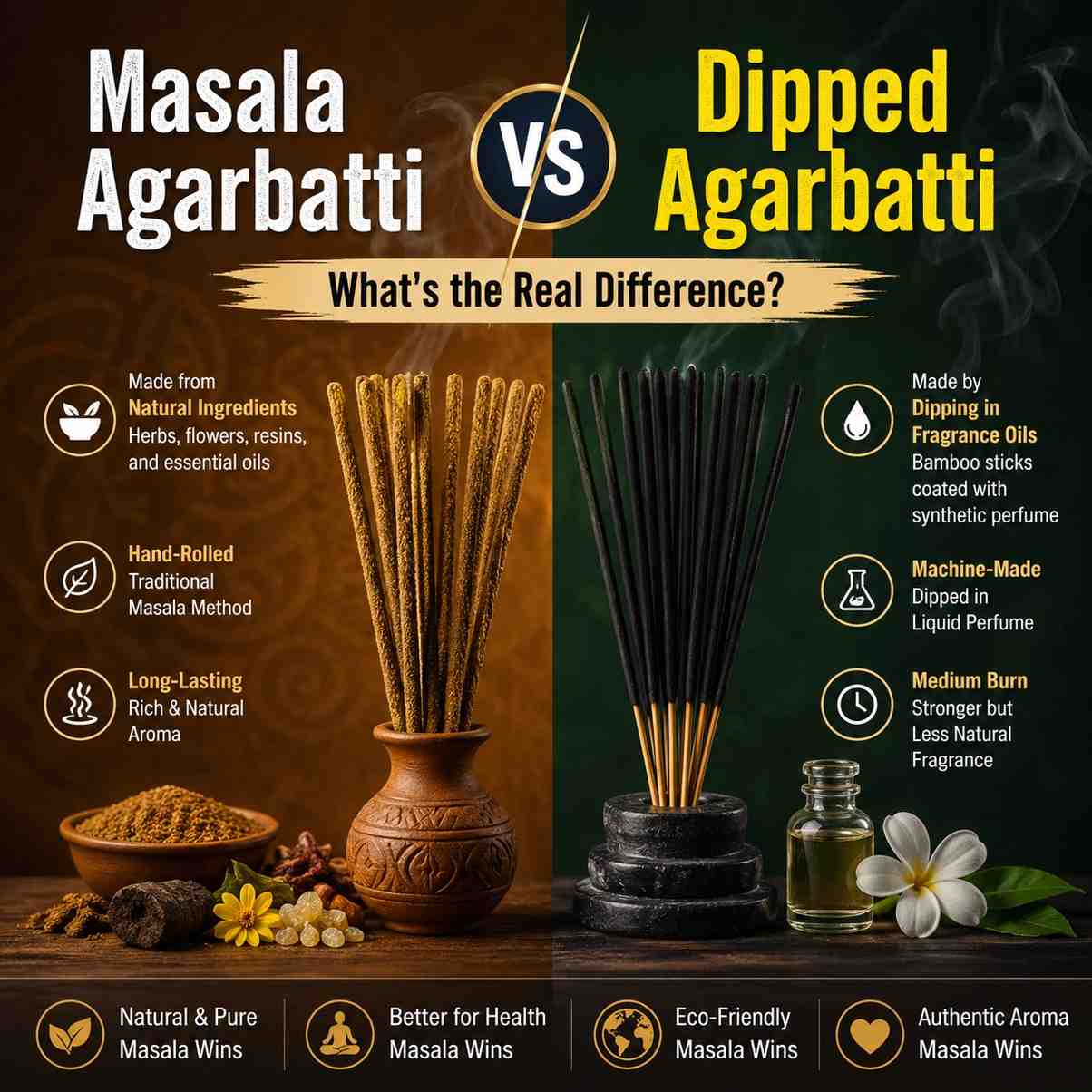
Walk into any Indian home before morning puja, and the first thing that hits you is the scent of agarbatti. But here’s what most people don’t know: not all incense sticks are made the same way. There are two fundamentally different manufacturing methods — masala agarbatti and dipped agarbatti — and the difference between them affects everything from fragrance quality to how long the scent lasts to whether it’s safe to breathe indoors.
If you’ve ever wondered why one agarbatti fills the whole room while another barely gives off any smell, or why some smoke turns black and harsh while others burn clean — this guide explains exactly why.
First, What Is Agarbatti Made Of?
At its core, every agarbatti starts with the same basic structure: a thin bamboo stick coated with a combustible base material. What separates masala from dipped agarbatti is what gets mixed into that base — and how the fragrance is added.
Masala Agarbatti: The Traditional Method
Masala agarbatti is made the old-fashioned way — the way Indian artisans have been making incense for centuries.
In this method, dry aromatic ingredients (called masala) are blended together into a paste and hand-rolled directly onto the bamboo stick. The masala mixture typically includes:
- Jigat or halmaddi — a natural adhesive binder made from plant resins
- Charcoal or wood powder — to help the stick burn evenly
- Aromatic herbs and spices — sandalwood powder, tulsi, nagchampa flower, guggal, loban, cloves, and other botanicals
- Natural essential oils or attars — added into the paste itself
The key difference is that the fragrance is baked into the stick from the inside. When you burn it, you’re releasing the natural aromatic compounds from actual plant-based ingredients — not synthetic chemicals sprayed on the outside.
Why Masala Agarbatti Smells Better
Because the fragrance comes from real botanical ingredients embedded throughout the stick, masala agarbatti tends to:
- Produce a richer, more complex scent with natural top, middle, and base notes
- Last longer in the air — the fragrance lingers for hours after the stick goes out
- Smell different at each stage of burning — the opening note, the mid-burn, and the dry-down are all slightly distinct
- Leave a pleasant residual fragrance in the room, not just while burning
You’ll notice that a good masala agarbatti often smells even better an hour after burning than it did while the stick was lit. That’s the botanical material doing its work.
Dipped Agarbatti: The Industrial Method
Dipped agarbatti is a product of modern mass manufacturing. In this method, plain unscented sticks (called white sticks or blank sticks) are produced first — these are basic bamboo sticks coated with a simple combustible base that has no fragrance of its own.
These blank sticks are then dipped into or sprayed with synthetic fragrance oils — a quick, inexpensive process that coats the outside of the stick with scent.
The fragrance in dipped agarbatti is almost always made from:
- Synthetic aromatic chemicals — lab-created compounds that mimic natural scents
- DPG (Dipropylene Glycol) — a carrier solvent used to dilute the fragrance
- Petrochemical-derived fixatives — to help the scent bind to the stick
This method is faster, cheaper, and far easier to scale. It’s why most mass-market agarbatti you find in convenience stores is dipped — it costs a fraction to produce and can be manufactured in enormous quantities.
The Trade-Off With Dipped Agarbatti
The problem with the dipping method isn’t just fragrance quality — it’s also what you’re burning.
When you light a dipped agarbatti, the synthetic fragrance chemicals on the surface combust along with the bamboo and base material. Many synthetic fragrance compounds, when burned, release:
- Volatile Organic Compounds (VOCs) like benzene and toluene
- Carbon monoxide in higher concentrations than natural burning materials
- Particulate matter — the visible black smoke that coats walls over time
This is why heavily dipped agarbatti often produces thick black smoke, leaves a dark residue on walls near where it’s burned regularly, and can cause headaches or irritation — especially in enclosed rooms.
The scent also tends to be one-dimensional — sharp and synthetic at first, then quickly fading. There’s no depth or evolution to the fragrance because there’s no real botanical material releasing aromatic compounds as it burns.
Side-by-Side Comparison
| Feature | Masala Agarbatti | Dipped Agarbatti |
|---|---|---|
| Fragrance source | Natural botanicals in the paste | Synthetic oils on the surface |
| Scent quality | Rich, layered, complex | Flat, one-note, sharp |
| Scent longevity | Long-lasting, lingers after burning | Fades quickly |
| Smoke | Thin, lighter coloured | Often thick, black |
| Ingredients | Herbs, resins, natural oils | Synthetic chemicals, DPG |
| Indoor air quality | Gentler on airways | Can release VOCs |
| Production method | Hand-rolled by artisans | Machine-made, industrial |
| Price | Higher | Lower |
| Shelf life | Very long (dry masala stays potent) | Degrades faster as surface fragrance evaporates |
How to Tell Which One You’re Buying
Since packaging rarely says “masala” or “dipped” clearly, here’s how to figure it out before you buy:
Look at the stick itself. A masala agarbatti will have a slightly textured, grainy surface — you can see the dried paste coating. A dipped agarbatti will look smoother and more uniform, sometimes slightly shiny or oily to the touch.
Smell it unlit. Masala agarbatti has a softer, more natural raw scent when unlit — like herbs or dried flowers. Dipped agarbatti often smells very strong and synthetic even before burning, because the fragrance is sitting on the surface.
Watch how it burns. Light both and observe. Masala agarbatti produces lighter, wispier smoke. Dipped agarbatti often produces visibly darker, heavier smoke — especially in the first few seconds.
Check the price. There’s no shortcut here. Natural botanicals, hand-rolling, and quality resins cost more. If you’re buying 100 sticks for ₹30, it’s dipped. Premium masala agarbatti is priced higher because it costs more to make properly.
Which One Should You Use?
For daily puja at home, the answer is almost always masala agarbatti — especially if you’re burning it in smaller spaces like a pooja room, bedroom, or hall. The natural ingredients are gentler on your lungs, the scent is more authentic, and the fragrance genuinely elevates the atmosphere rather than just filling it with a chemical cloud.
Dipped agarbatti has its place for outdoor use — large temple grounds, community havans, or spaces where ventilation isn’t a concern and cost matters more than quality.
If you’ve been burning incense for years and noticed headaches, a coating on your walls, or a scent that disappears the moment the stick goes out — there’s a good chance you’ve been using dipped agarbatti without knowing it.
The Melloow Luxury Difference
At Melloow Luxury, every agarbatti we make uses the masala method — real ingredients, hand-rolled, with natural essential oils and botanical resins that actually belong in your home. We believe the fragrance that fills your puja space should be as natural as the ritual itself.
If you’re ready to make the switch to genuine masala agarbatti, browse our collection and experience what real Indian incense is supposed to smell like.