

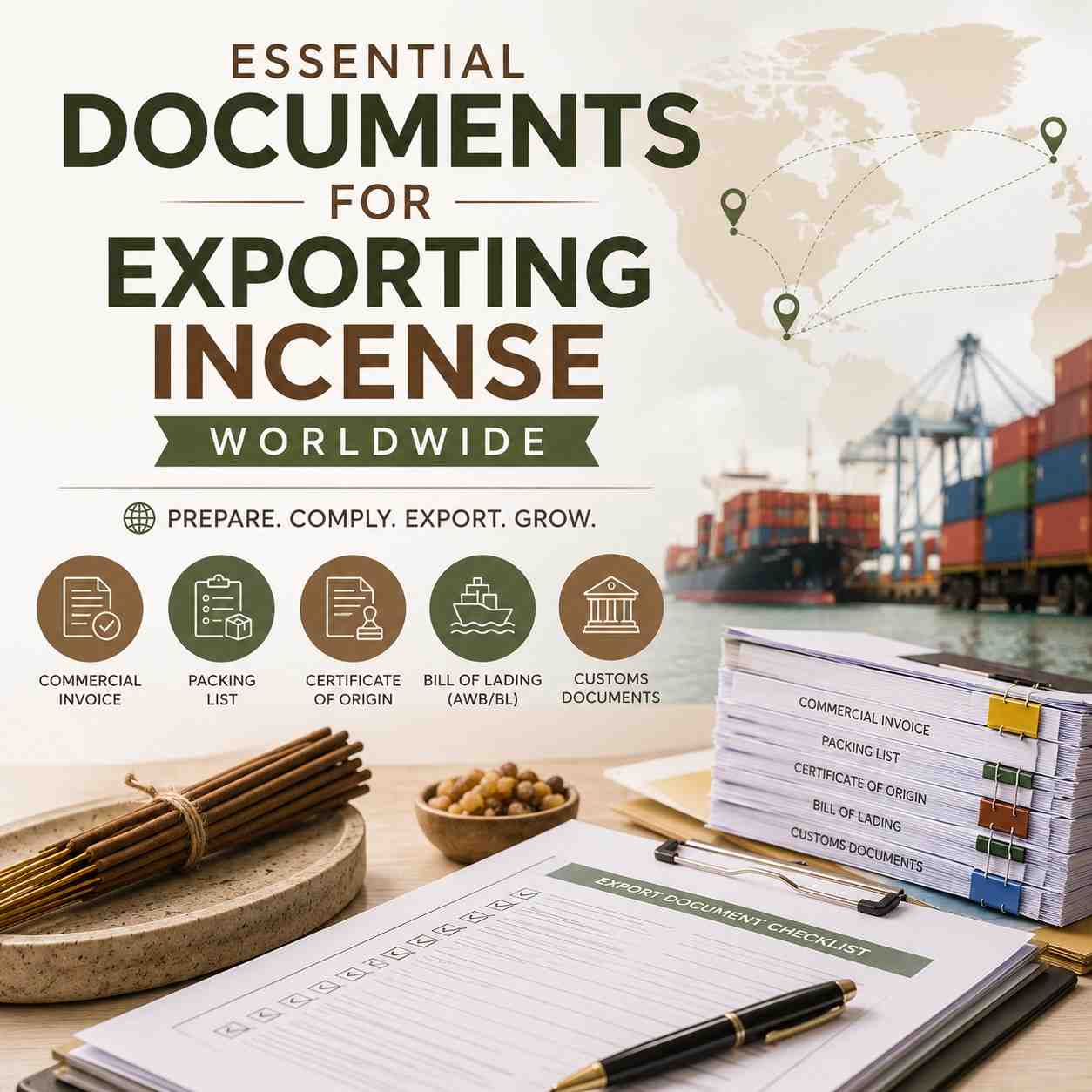
India is the world’s largest producer and exporter of incense products, supplying premium agarbatti, dhoop sticks, bambooless incense, and luxury fragrances to markets across the globe.
With increasing demand from countries such as:
- United States
- United Kingdom
- UAE
- Saudi Arabia
- Australia
- Canada
- Germany
- France
- South Africa
the incense export industry presents tremendous growth opportunities for manufacturers and exporters.
However, exporting incense products requires proper documentation, compliance, and logistics planning.
At Melloow Luxury, we understand the importance of maintaining international quality standards and ensuring smooth export operations. This guide covers everything businesses need to know about incense export documentation.
Why the Global Demand for Indian Incense Is Growing
Indian incense products are highly valued worldwide because of their:
- Authentic fragrances
- Traditional craftsmanship
- Natural ingredients
- Competitive pricing
- Wide fragrance variety
Consumers across international markets are increasingly seeking:
- Luxury incense sticks
- Low-smoke agarbatti
- Bambooless incense
- Aromatherapy products
- Premium home fragrance solutions
This growing demand makes incense exports one of the most promising sectors in the fragrance industry.
Essential Documents Required for Incense Export
Proper documentation is critical for successful international trade.
Missing or incorrect paperwork can lead to:
- Customs delays
- Shipment holds
- Additional costs
- Import rejection
Let’s explore the key documents required.
1. Import Export Code (IEC)
The first requirement for any export business in India is obtaining an Import Export Code (IEC).
Issued by the Directorate General of Foreign Trade, the IEC is mandatory for:
- Exporting products internationally
- Receiving foreign payments
- Clearing customs
Without an IEC, export activities cannot legally take place.
2. Commercial Invoice
The commercial invoice serves as the primary sales document.
It contains:
- Exporter details
- Buyer details
- Product description
- Quantity
- Unit price
- Total value
- Currency used
- Terms of sale
Customs authorities use this document to assess shipment value.
3. Packing List
A packing list provides detailed information about:
- Number of cartons
- Weight
- Dimensions
- Packaging specifications
- Product quantities
This document helps customs officials and logistics providers verify shipment contents.
4. Purchase Order or Sales Contract
A purchase order or sales agreement confirms:
- Product specifications
- Agreed pricing
- Payment terms
- Delivery schedule
This document helps avoid misunderstandings between exporter and importer.
5. Shipping Bill
The shipping bill is one of the most important export documents.
It is filed through Indian customs and contains:
- Export details
- Product information
- Destination country
- Shipment value
Customs clearance cannot proceed without a shipping bill.
6. Bill of Lading or Airway Bill
This transportation document is issued by:
- Shipping companies
- Airlines
Depending on the shipment mode.
For Sea Freight:
Bill of Lading (BL)
For Air Freight:
Airway Bill (AWB)
These documents act as proof that goods have been shipped.
7. Certificate of Origin (COO)
Many international buyers require a Certificate of Origin.
This document confirms:
The incense products were manufactured in India.
Benefits include:
- Trade agreement eligibility
- Reduced import duties in some countries
- Customs compliance
8. GST Documentation
Exporters should maintain proper GST records, including:
- GST invoices
- LUT (Letter of Undertaking) where applicable
- Export filing records
Proper GST compliance helps streamline export benefits and refunds.
9. Bank Realization Certificate (BRC)
Once payment is received from the international buyer, the bank issues a Bank Realization Certificate.
This document serves as proof that:
- Export proceeds have been received
- Foreign currency payment was completed
It is often required for claiming export incentives.
10. Product Specifications Sheet
Many international buyers request detailed product specifications.
For incense products, this may include:
Product Type
- Masala incense
- Bambooless incense
- Dhoop sticks
Fragrance Details
- Sandalwood
- Oud
- White Musk
- Lavender
- Rose
Burning Time
Average burn duration per stick.
Packaging Information
Retail and bulk packaging details.
Additional Certifications That May Be Required
Depending on the destination country, additional certifications may be requested.
MSDS (Material Safety Data Sheet)
Some importers request an MSDS to verify:
- Product composition
- Safe handling procedures
- Transportation compliance
Especially for large commercial shipments.
Phytosanitary Requirements
Certain countries may request declarations related to:
- Natural materials
- Plant-derived ingredients
Although requirements vary by market.
Quality Certifications
Premium manufacturers often maintain certifications that build buyer confidence.
Examples include:
- ISO certifications
- Quali
Exporters generally use:
Air Freight
Ideal for:
- Small shipments
- Urgent orders
- Premium products
Benefits:
- Faster delivery
- Reduced transit time
Challenges:
- Higher shipping costs
Sea Freight
Ideal for:
- Bulk incense exports
- Wholesale orders
- Large-volume shipments
Benefits:
- Lower cost per unit
Challenges:
- Longer transit times
Top Export Markets for Indian Incense
Indian incense products enjoy strong demand in:
Middle East
- United Arab Emirates
- Saudi Arabia
- Qatar
- Oman
Europe
- Germany
- France
- Netherlands
North America
- United States
- Canada
Asia-Pacific
- Australia
- Singapore
Tips for Successful Incense Exporting
Maintain Consistent Quality
International buyers expect:
- Uniform fragrance
- Consistent burn quality
- Reliable packaging
Invest in Attractive Packaging
Premium packaging helps products stand out in:
- Retail stores
- Online marketplaces
- Gift segments
Understand Import Regulations
Every country has different:
- Customs requirements
- Labeling standards
- Product regulations
Research before shipping.
Build Long-Term Relationships
Successful export businesses focus on:
- Reliability
- Communication
- Quality assurance
Long-term buyers often generate recurring business.
How Melloow Luxury Supports International Markets
At Melloow Luxury, we focus on creating premium incense products designed for global consumers.
Our offerings include:
- Luxury incense sticks
- Low-smoke agarbatti
- Premium fragrance collections
- Export-ready packaging
- International quality standards
We understand the importance of documentation, compliance, and product consistency when serving international buyers.
Future of Incense Exports
The global home fragrance market continues to expand.
Growing demand for:
- Wellness products
- Luxury fragrances
- Aromatherapy solutions
- Premium home ambience
is creating new opportunities for incense exporters worldwide.
Manufacturers that combine:
- Quality
- Innovation
- Compliance
- Strong branding
will be best positioned for long-term export success.
Final Thoughts
Exporting incense products can be highly rewarding, but success depends on proper preparation and documentation.
By maintaining accurate export records, complying with customs requirements, and delivering premium-quality products, businesses can confidently expand into international markets.
Whether you’re exporting traditional agarbatti, luxury incense, or modern home fragrance products, understanding export documentation is the foundation of sustainable global growth.
For brands like Melloow Luxury, exporting is not just about shipping products—it’s about sharing India’s rich fragrance heritage with the world.
Great content! Keep up the good work!